
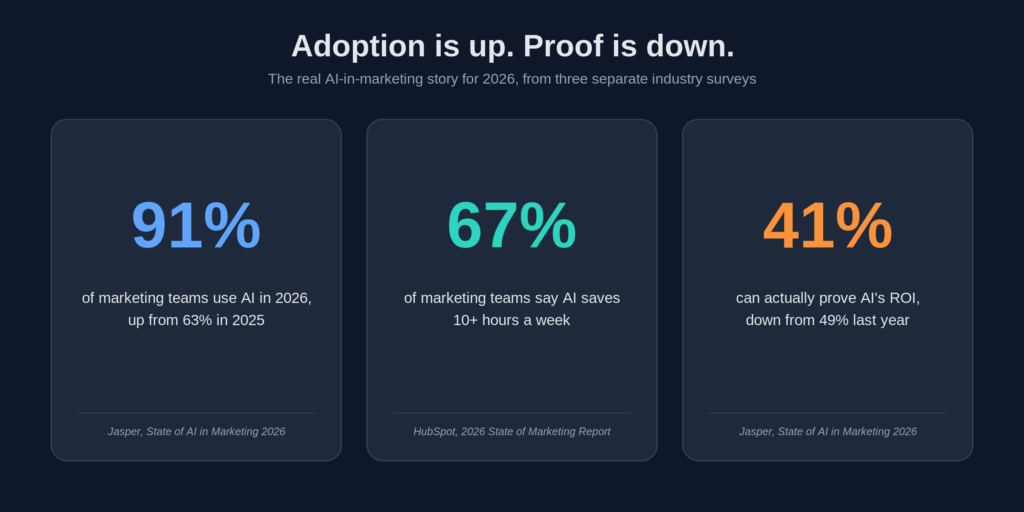
AI adoption in marketing jumped from 63% to 91% in a year, and most teams report saving 10+ hours a week. But the share who can prove AI's ROI actually fell, from 49% to 41%.
AI saves me real hours in marketing. It also wastes real hours, just not where most "AI marketing" content admits it does.
Sixty seven percent of marketing teams now say AI saves them ten or more hours a week, according to HubSpot's 2026 State of Marketing report. Marketer adoption jumped from 63% to 91% in a single year, per Jasper's State of AI in Marketing 2026 report. But in that same survey, the share of marketers who can actually prove AI's return on investment fell, from 49% down to 41%. More people are using AI. Fewer can show it is paying off.
That gap is the real story, and almost nobody in performance marketing writes about it honestly. I run paid media and marketing operations day to day, out of Dubai, on accounts that spend real budget. AI has changed genuine parts of my week. It has also created a category of cleanup work that never makes it into the "ten hours saved" headline. Here is where each one actually happens.
In this article:
- Where AI actually earns its keep
- Ad copy and content: a first draft machine, not a copywriter
- Research, reporting, and turning ten tabs into one brief
- Where AI just makes a mess
- Performance Max, AI Max, and Advantage+: the black box problem
- When AI is confidently wrong, and nobody catches it for a week
- What actually happens on real accounts
- FAQ
Where AI actually earns its keep
The tasks where AI genuinely saves me time share one trait. There is a known good format, and a person checks the output before it goes near a client or a live campaign.
McKinsey's research on AI in marketing and sales found that companies investing in AI report a revenue uplift of 3 to 15%, and a sales ROI uplift of 10 to 20%. That gain does not come from AI running campaigns unsupervised. It comes from AI compressing the gap between "I need to understand this" and "I understand this", so the week has more room for decisions and less for assembly work.
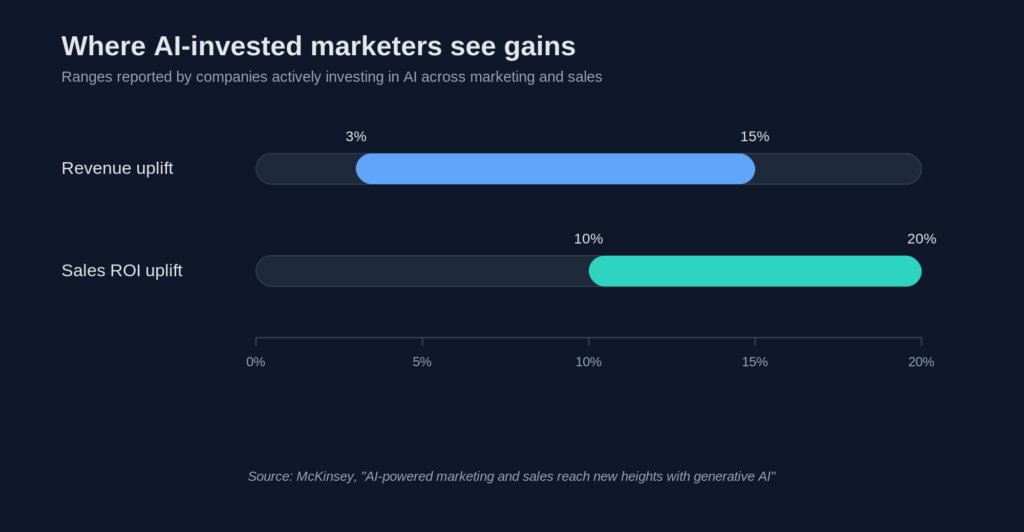
Companies actively investing in AI report a 3 to 15% revenue uplift and a 10 to 20% sales ROI uplift. The gains come from faster analysis and drafting, not from AI making unsupervised decisions.
Three places that shows up for me every week: drafting, research, and reporting.
Ad copy and content: a first draft machine, not a copywriter
Give an AI tool a product, an audience, and a few examples of the tone you want, and it will produce a full set of headline and description variants for a search ad campaign faster than you can open a spreadsheet. That part is genuinely useful. Writing a dozen headline and description combinations by hand, checking character counts, and making sure none of them repeat is slow, mechanical work. AI handles the mechanical part well.
What it does not do well is know when a line is flat. A headline that technically fits the character limit and says nothing memorable will pass every automated check and still under-perform in the account. So the rule I use is simple: AI writes the first pass, I cut half of it, and I rewrite whichever line is supposed to carry the actual offer. The time saved is real. It is just not the whole job.
Research, reporting, and turning ten tabs into one brief
This is where the time savings are least argued about, mostly because they are the most boring to talk about. Summarising a week of platform data, a competitor's landing page changes, or a client's category into a plain English brief used to eat an afternoon. Feeding the raw data in and asking for a first pass summary now turns that into a task measured in minutes, with the actual analysis and framing left to a person.
The failure mode here is not quality, it is laziness. It is tempting to paste the AI's summary straight into a client update without checking whether the numbers actually reconcile with the source data. They do not always. More on that further down.
| Task | AI saves time when | AI costs time when |
|---|---|---|
| First draft ad copy and content | You treat it as a starting point | You skip the human edit pass |
| Research and reporting summaries | You reconcile the numbers against source data | You paste the summary straight into a client update |
| Automated campaign types (Advantage+, AI Max) | Exclusions and conversion data are strong going in | Inputs are weak and the system scales them anyway |
| Judgement calls presented as fact | Rarely, this needs a person | A hallucinated or stale figure gets published as real |
Where AI just makes a mess
The tasks that go badly share the opposite trait to the ones above. There is no clean known good format to check against, the tool is making a judgement call, or the output touches live budget before a person has looked at it.
Two places this costs me more time than it saves: automated ad platform decisioning, and unverified AI output presented as fact.
Performance Max, AI Max, and Advantage+: the black box problem
Google and Meta have both pushed hard toward AI-run campaign types. Meta says 82% of its advertisers now use some form of Advantage+ automation. Google's newer AI Max for Search, which is not the same product as Performance Max even though the two get conflated constantly, hands advertisers a genuine trade-off. An analysis of more than 250 retail campaigns by Smarter Ecommerce found a median revenue uplift of 13% alongside a median CPA increase of 16%, with individual campaign ROAS outcomes ranging from plus 42% to minus 35%.
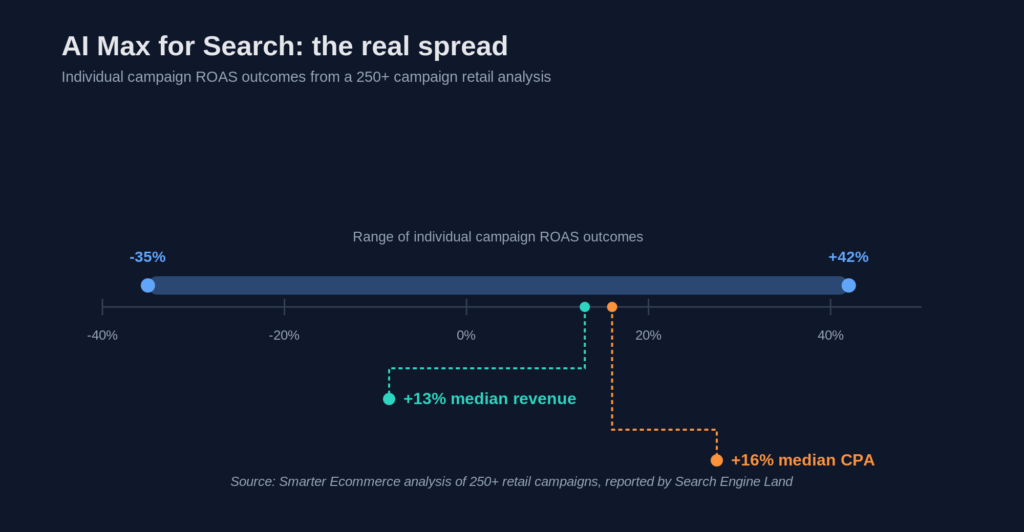
The median result looks fine. The spread underneath it does not. A tool that can swing 42% in either direction isn't doing your strategy for you, it's amplifying whatever you fed it.
That spread is the tell. When an automated system can deliver a 42% swing in either direction depending on the account, the tool is not doing your strategy for you. It is amplifying whatever exclusions, conversion data, and creative quality you gave it. Good inputs get scaled well. Weak inputs get scaled badly, just faster than before.
The actual complaint I hear most from other people running paid media is not that these tools under-perform. It is that they are a black box: you cannot see why the algorithm chose a specific audience or asset combination, so when performance dips, diagnosing it takes longer than it would with a campaign you built and can inspect line by line. The time AI claims to save on campaign setup gets partly handed back during troubleshooting.
When AI is confidently wrong, and nobody catches it for a week
Large language models still hallucinate, and the rates are not trivial. On Vectara's hallucination leaderboard, the best performing models sit in the low single digits on straightforward summarisation tasks, and several widely used models range higher, particularly on longer or more technical source material. Marketing documents, pricing pages, and performance data are exactly the kind of material where that error rate bites.
A wrong number in an AI-drafted summary does not announce itself. It reads as confidently as the correct numbers sitting next to it. That is the actual risk, not that AI produces obviously broken output, but that it produces plausible sounding output that is wrong in a way a tired reviewer skims straight past. Trust is already thin on this point. Consumer comfort with brands using AI in advertising has been falling year over year, and a large share of people now say they feel uneasy about how AI shows up in the ads they see. Publishing a mistake an AI made does not just cost you the fix. It spends some of that already shrinking trust.
What actually happens on real accounts
On the accounts I manage, the rule is that AI is never the last check before something goes live or goes out. It drafts ad copy, but a person picks the final set. It summarises performance data, but a person reconciles the headline numbers against the platform before they reach a client. It can suggest audience or asset combinations inside Advantage+ or AI Max, but exclusions and budget guardrails are set and reviewed by a person, not left on autopilot. That one rule is the difference between AI saving genuine hours a week and AI quietly creating cleanup work that was not there before.
FAQ
Does AI actually save marketers time in 2026?
Yes, for specific tasks. HubSpot's 2026 State of Marketing report found 67% of marketing teams save ten or more hours a week using AI, mostly on drafting, research, and reporting rather than strategy or judgement calls.
Should I let Performance Max or Advantage+ run fully automated?
Not without exclusions, conversion data, and creative quality set by a person first. An analysis of over 250 retail AI Max campaigns found results ranging from plus 42% to minus 35% ROAS, which shows the automation amplifies your inputs rather than replacing your strategy.
Why does AI-generated ad copy sound generic?
Because it is trained to produce safe, average output across every account it has ever seen. It is a strong first draft, not a finished one. Treat it as a starting point you cut and rewrite, not a copywriter you can skip reviewing.
How often do AI tools get marketing data wrong?
More often than most people check for. Hallucination rates on leading models range from roughly 1% to over 10%, depending on the model and the complexity of the source material, per Vectara's hallucination leaderboard. Always reconcile AI-summarised numbers against the original source before sharing them.
What is the safest way to start using AI in a marketing team?
Start with tasks that have a known good format and a human review step before anything reaches a client or live budget: first draft copy, research summaries, and reporting. Keep AI away from unsupervised decisions on spend, targeting, or anything that goes out under your brand's name.
The honest takeaway: AI is a genuine time saver on drafting, research, and reporting, and a genuine time cost anywhere it is making judgement calls without a person checking its work. Treat it like a fast, occasionally wrong intern rather than a replacement for your strategy, and the maths works in your favour. If you want a second pair of eyes on where AI is actually helping your team and where it is quietly costing you time, get in touch.
Related reading: How I structure Google Ads exclusions before handing a campaign to AI Max. What I actually check before trusting an AI-written client report. Why consumer trust in AI-made ads keeps falling, and what that means for your creative.